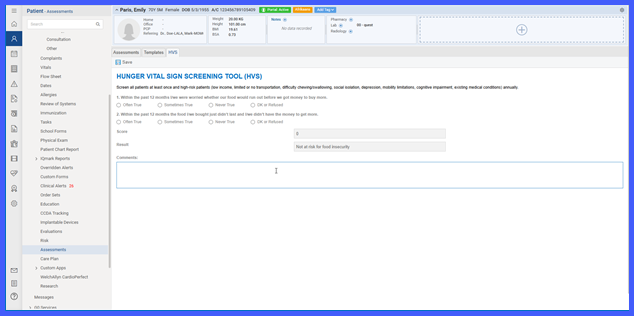
Support for Hunger Vital Sign Screening in Assessments
What’s New
-
New Assessment Added:
-
Hunger Vital Sign (HVS) screening form (LOINC 88121-9) available in the Assessments list.
-
-
Standardized Question Set:
-
Includes two mandatory questions mapped to:
-
LOINC 88122-7
-
LOINC 88123-5
-
-
-
Coded Answer Options:
-
“Often true” (LA28397-0)
-
“Sometimes true” (LA6729-3)
-
“Never true” (LA28398-8)
-
“DK or Refused” (LA30968-4) — not scored
-
-
Mandatory Responses:
-
Each question must be answered before submission.
-
-
Automated Scoring:
-
“Often true” and “Sometimes true” = 1 point each.
-
-
Result Field:
-
Displays food insecurity risk (LOINC 88124-3).
-
-
Form Layout Update:
-
Score and risk result displayed at the bottom of the form.
-
Name, DOB, and Age excluded from the form (already visible in the patient banner).
-
How It Works
-
Open a patient record and go to the Assessments section.
-
Select Add, then choose Hunger Vital Sign from the list.
-
The assessment opens with two mandatory questions:
-
“Within the past 12 months, we worried whether our food would run out before we got money to buy more.”
-
“Within the past 12 months, the food we bought just didn’t last and we didn’t have money to get more.”
-
-
Select a coded answer for each question:
-
Often true, Sometimes true, Never true, or DK/Refused.
-
-
Click Save or Submit to record responses.
-
The system calculates the score automatically:
-
1 point each for Often true or Sometimes true.
-
-
The result field at the bottom displays the Food Insecurity Risk (LOINC 88124-3).
-
The form omits redundant patient identifiers (Name, DOB, Age) since they appear in the banner.
Benefits
-
Enables standardized documentation of food insecurity using validated LOINC codes.
-
Ensures complete data capture with mandatory questions and coded responses.
-
Provides automatic scoring and clear visualization of risk results.
-
Enhances interoperability and reporting accuracy with LOINC/UCUM compliance.
-
Improves clinical assessment workflows for social determinants of health.