Anesthesia Billing Process
Anesthesia Billing
Anesthesia care is provided by an anesthesia practitioner who may be a physician, a certified registered nurse anesthetist (CRNA) with or without medical direction, or an anesthesia assistant (AA) with medical direction. The anesthesia care package consists of preoperative evaluation, standard preparation and monitoring services, administration of anesthesia, and post-anesthesia recovery care.
Anesthesiologists may personally perform anesthesia services or may supervise anesthesia services performed by a CRNA or AA. CRNAs may perform anesthesia services independently or under the supervision of an anesthesiologist or operating practitioner. An AA always performs anesthesia services under the direction of an anesthesiologist. Anesthesiologists personally performing anesthesia services and non-medically directed CRNAs bill in a standard fashion in accordance with the Centers for Medicare & Medicaid Services (CMS) regulations.
Standard Anesthesia Coding
The following policies reflect national Medicare correct coding guidelines for anesthesia services.
CPT codes 00100-01860 specify “Anesthesia for” followed by a description of a surgical intervention. CPT codes 01916-01936 describe anesthesia for radiological procedures. Several CPT codes (01951-01999, excluding 01996) describe anesthesia services for burn excision / debridement, obstetrical, and other procedures. CPT codes 99151-99157 describe moderate (conscious) sedation services. Anesthesia services include, but are not limited to, preoperative evaluation of the patient, administration of anesthetic, other medications, blood, and fluids, monitoring of physiological parameters, and other supportive services. Anesthesia codes describe a general anatomic area or service which usually relates to a number of surgical procedures, often from multiple sections of the “CPT Manual”.
For Medicare purposes, only one anesthesia code is reported unless the anesthesia code is an Add-on Code (AOC). In this case, both the code for the primary anesthesia service and the anesthesia AOC are reported according to “CPT Manual” instructions.
Time Units
A unique characteristic of anesthesia coding is the reporting of time units. Payment for anesthesia services increases with time. In addition to reporting a base unit value for an anesthesia service, the anesthesia practitioner reports anesthesia time. Anesthesia time is defined as the period during which an anesthesia practitioner is present with the patient. It starts when the anesthesia practitioner begins to prepare the patient for anesthesia services in the operating room or an equivalent area and ends when the anesthesia practitioner is no longer furnishing anesthesia services to the patient (i.e., when the patient may be placed safely under postoperative care).
Anesthesia time is a continuous time period from the start of anesthesia to the end of an anesthesia service. In counting anesthesia time, the anesthesia practitioner can add blocks of time around an interruption in anesthesia time as long as the anesthesia practitioner is furnishing continuous anesthesia care within the time periods around the interruption.
CureMD Anesthesia Billing Configuration
CureMD supports anesthesia billing with time-based calculations in accordance with CMS guidelines. The configuration process includes enabling anesthesia billing, entering base units, setting time units, and applying the correct conversion factors.
-
Enabling Anesthesia Billing – Practices can activate anesthesia billing features by contacting support. Once enabled, it will allow documentation and calculation of anesthesia time for procedures.
-
Base Units – Base units for anesthesia CPT codes are provided by the practice and must be set within the system to ensure accurate billing.
-
Time Units – Time for anesthesia services is recorded and calculated in 15-minute increments, following CMS standards.
-
Conversion Factor – Each year, CMS releases updated conversion factors that vary by locality and by provider type (Anesthesiologist or CRNA). These values must be entered in the system for accurate charge calculations.
Once configured, CureMD will automatically calculate charges based on the formula:
(Base Units + Time Units) × Conversion Factor
Anesthesia Charge Calculation:
Medicare & Commercial:
Base Units = (To be added in CPT settings) 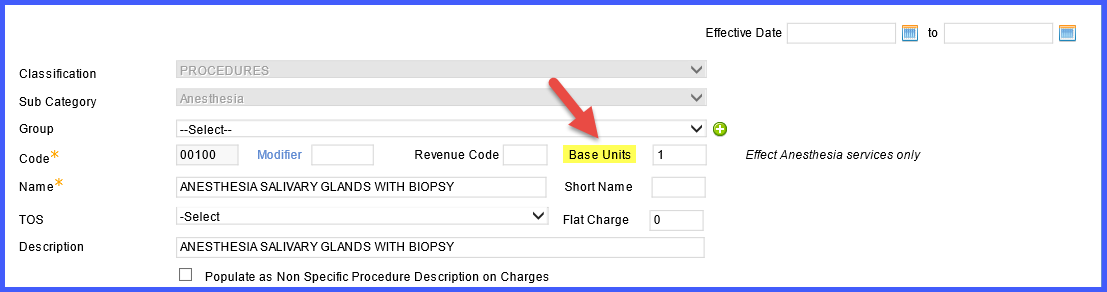
Time Units = (Procedure Time Units / 15 mins) 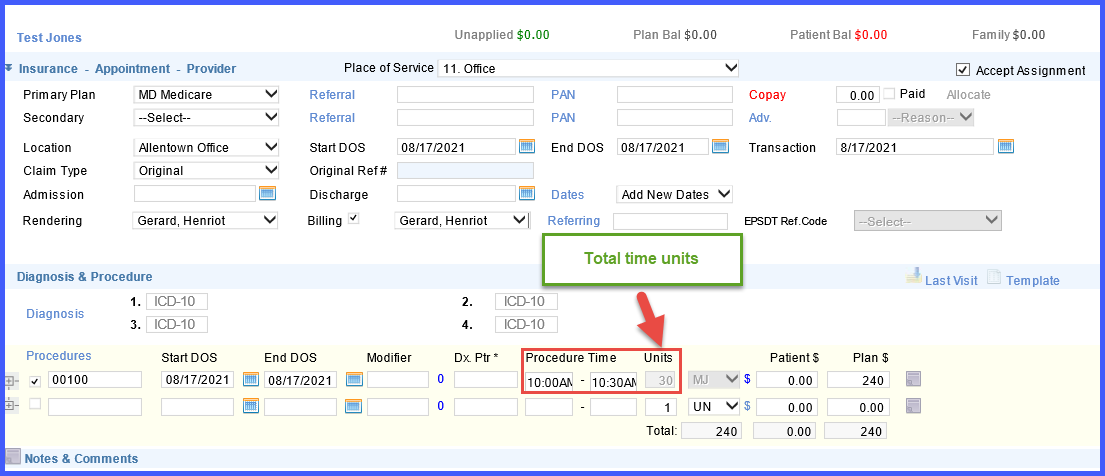
Conversation Factor = To be added in Location Settings 
Formula:
(Base Units + Time Units) x Conversion Factor
For example:
Base Units for CPT 00100 = 8
Time Units for Procedure = 10:00 AM to 10:30 AM = 30 Mins / 15Mins
Conversion Factor = 80
Charge Amount = (8 + 30/15) x 80
= (8 + 2) x 80
= 640 +160
= $ 800
What’s New
Settings Billing > Plan > Edit Plan, under Miscellaneous, a new section of Anesthesia needs to be created with a checkbox named Default Unit Count.
Under this checkbox 1Unit = () Minutes, Up to () Minutes, After () Minutes, Extended per unit = () Minutes
When this check box is enabled then time units will be replaced by the following Unit.
Example
1Unit = “15” Minutes up to “90” Minutes
After “90” Minutes, The extended per unit = “15”Minutes
So if a patient Start time is 09:00AM and End Time Is 11:00AM then the Total Units are = 90/15 for first (90 minutes)+ (30)/15 (for exceed 30 minutes) = 6+2=8 units
Now as per Formula, the charge amount is
Formula:
(Base Units + Time Units) x Conversion Factor
Base Units for CPT 00100 = 8
Time Units for Procedure = 10:00 AM to 11:00 AM = 8
Conversion Factor = 80
Charge Amount = (8 +8) x 80
= 640 +640
= $ 1280
Personal Health Modifier
Personal Health Modifiers (P0–P6), also known as P-Status Modifiers are now configured and should be calculated as below for all payers except Medicare
P3 is +1; P4 is +2; P5 is +3;
When any of the above three Modifier is used then the charge amount calculation formula is as below.
Formula:
(Base Units + Time Units + P Status) x Conversion Factor
- Medicare doesn’t pay for the P-Status Modifiers; they only use them as informational and therefore would not add to the total fee.
Now as per Formula the charge amount is when the plan check box is enabled
Formula:
(Base Units + Time Units+ P Status) x Conversion Factor
Base Units for CPT 00100 = 8
Time Units for Procedure = 10:00 AM to 11:00 AM = 8
P4 modifier is used then P Status = 2
Conversion Factor = 80
Charge Amount = (8 + 8 + 2 ) x 80
= 640 + 640 + 160
= $ 1,440
Now as per Formula the charge amount is when the plan check box is Disabled
Formula:
(Base Units + Time Units+ P Status) x Conversion Factor
Base Units for CPT 00100 = 8
Time Units for Procedure = 10:00 AM to 11:00 AM = 120 Mins / 15Mins
P4 modifier is used then P Status = 2
Conversion Factor = 80
Charge Amount = (8 + 120/15 + 2 ) x 80
= (8 + 8 + 2) x 80
= 640 + 640 + 160
= $ 1440
